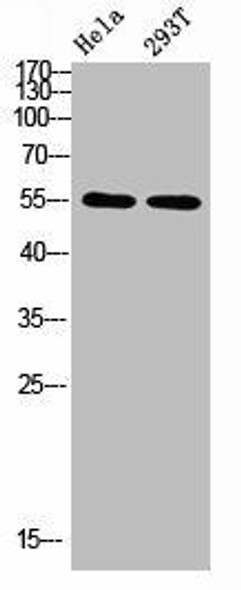
The Tuba8 Antibody (PAC012984) is a high-quality polyclonal antibody designed for research involving Tuba8, a protein that plays a vital role in cell biology and cellular functions. The antibody, raised in rabbits, is highly specific for Tuba8 and is validated for use in various experimental applications, including Western blotting and immunofluorescence.Tuba8 is a member of the Tubulin superfamily, with important functions in cell division, cell motility, and intracellular transport. It is specifically involved in microtubule organization and stabilization, making it a crucial target for studies in cell biology and cancer research.
The Tuba8 Antibody binds specifically to Tuba8 protein, enabling researchers to detect and analyze its expression in different cell types and tissues.Research on Tuba8 is essential for understanding its role in cellular processes and its potential implications in diseases like cancer and neurodegenerative disorders. By studying the function and regulation of Tuba8, researchers can gain valuable insights into mechanisms of disease and potentially uncover new therapeutic targets. The Tuba8 Antibody provides a powerful tool for investigating the functions of Tuba8 and advancing research in cell biology and related fields.
TUBA8: Tubulin is the major constituent of microtubules. It binds two moles of GTP, one at an exchangeable site on the beta chain and one at a non-exchangeable site on the alpha-chain. Defects in TUBA8 are the cause of polymicrogyria with optic nerve hypoplasia (PMGONH). It is a disease characterized by extensive polymicrogyria, optic nerve hypoplasia, severe developmental delay, hypotonia, seizures, a dysplastic or absent corpus callosum and colpocephaly. Polymicrogyria is a malformation of the cortex in which the brain surface is irregular and characterized by an excessive number of small gyri with abnormal lamination. Belongs to the tubulin family. 2 isoforms of the human protein are produced by alternative splicing.Protein type: Cytoskeletal; Motility/polarity/chemotaxisChromosomal Location of Human Ortholog: 22q11.21Disease: Polymicrogyria With Optic Nerve Hypoplasia
UniProt Protein Details:
NCBI Summary:
The protein encoded by this gene is a bifunctional enzyme and is one of the four enzymes of the peroxisomal beta-oxidation pathway. The N-terminal region of the encoded protein contains enoyl-CoA hydratase activity while the C-terminal region contains 3-hydroxyacyl-CoA dehydrogenase activity. Defects in this gene are a cause of peroxisomal disorders such as Zellweger syndrome. Two transcript variants encoding different isoforms have been found for this gene. [provided by RefSeq, Oct 2009]