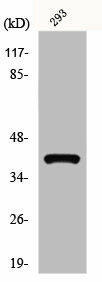


Description
TPR Antibody (PACO20133)
The TPR Antibody (PACO20133) is a polyclonal antibody specifically designed for research involving the TPR protein. This antibody, raised in rabbits, is highly reactive with human samples and has been validated for use in various applications, including Western blot and immunofluorescence.TPR, or Tetratricopeptide Repeat, is a protein motif found in a variety of cellular proteins, playing a critical role in protein-protein interactions and cellular processes such as signal transduction and protein folding. The TPR Antibody binds specifically to the TPR protein, enabling researchers to detect and analyze its expression in different cell types.
The TPR protein is involved in diverse biological functions, making it a valuable target for research in areas such as cell biology, signal transduction, and protein folding. Understanding the role of TPR in these processes can provide insights into various diseases and conditions, including cancer, neurodegenerative disorders, and infectious diseases.Overall, the TPR Antibody (PACO20133) is a valuable tool for researchers studying the TPR protein and its involvement in cellular processes, offering high specificity and sensitivity for detection and analysis in various research applications.
| Antibody Name: | TPR Antibody (PACO20133) |
| Antibody SKU: | PACO20133 |
| Size: | 50ul |
| Host Species: | Rabbit |
| Tested Applications: | ELISA, IHC |
| Recommended Dilutions: | ELISA:1:2000-1:5000, IHC:1:25-1:100 |
| Species Reactivity: | Human, Mouse, Rat |
| Immunogen: | Synthetic peptide of human TPR |
| Form: | Liquid |
| Storage Buffer: | -20°C, pH7.4 PBS, 0.05% NaN3, 40% Glycerol |
| Purification Method: | Antigen affinity purification |
| Clonality: | Polyclonal |
| Isotype: | IgG |
| Conjugate: | Non-conjugated |
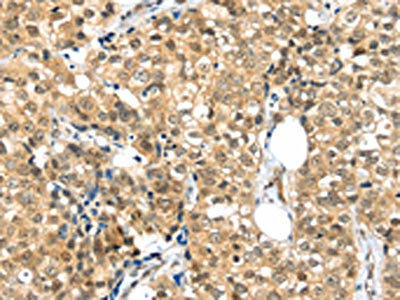 | The image on the left is immunohistochemistry of paraffin-embedded Human breast cancer tissue using PACO20133(TPR Antibody) at dilution 1/20, on the right is treated with synthetic peptide. (Original magnification: x200). |
| Background: | This gene encodes a large coiled-coil protein that forms intranuclear filaments attached to the inner surface of nuclear pore complexes (NPCs). The protein directly interacts with several components of the NPC. It is required for the nuclear export of mRNAs and some proteins. Oncogenic fusions of the 5' end of this gene with several different kinase genes occur in some neoplasias. |
| Synonyms: | translocated promoter region, nuclear basket protein |
| UniProt Protein Function: | TPR: a large coiled-coil nuclear pore protein that forms filamentous structures extending from nuclear pore complexes (NPCs) into the perinucleolar region. Together with Lamina-associated polypeptide 2 (LAP2) family members and Nup153, forms structural links between the nuclear lamina and the internal nuclear matrix. In interphase, localizes to the nucleoplasmic side of the nuclear pore complex (NPC) core structure, forming a fibrous structure called the nuclear basket. Essential for normal nucleocytoplasmic transport of proteins and mRNAs, plays a role in the establishment of nuclear-peripheral chromatin compartmentalization in interphase, and in the mitotic spindle checkpoint signaling during mitosis. Involved in the quality control and retention of unspliced mRNAs in the nucleus. Involved in the formation and/or maintenance of NPC-associated perinuclear heterochromatin exclusion zones (HEZs). Implicated in nuclear export of mRNAs transcribed from heat shock gene promoters; associates both with chromatin in the HSP70 promoter and with mRNAs transcribed from this promoter under stress-induced conditions. Translocations between human TPR and TrkA, MET, and RAF genes are oncogenic. Its N-terminus is involved in activation of oncogenic kinases. |
| UniProt Protein Details: | Protein type:Membrane protein, peripheral; Nuclear envelope; Nucleoporin; Oncoprotein Chromosomal Location of Human Ortholog: 1q31.1 Cellular Component: cytoplasm; cytoplasmic dynein complex; extrinsic to membrane; kinetochore; nuclear envelope; nuclear inclusion body; nuclear membrane; nuclear pore; nucleoplasm; nucleus Molecular Function:chromatin binding; heat shock protein binding; mitogen-activated protein kinase binding; mRNA binding; nucleocytoplasmic transporter activity; protein anchor; protein binding; protein homodimerization activity; RNA binding; transporter activity; tubulin binding Biological Process: mitotic cell cycle spindle assembly checkpoint; mitotic nuclear envelope disassembly; mRNA export from nucleus; mRNA export from nucleus during heat stress; negative regulation of RNA export from nucleus; negative regulation of transcription from RNA polymerase II promoter; negative regulation of translational initiation; nuclear matrix organization and biogenesis; nuclear pore complex assembly; nuclear pore organization and biogenesis; nuclear translocation of MAPK; positive regulation of heterochromatin formation; positive regulation of protein export from nucleus; positive regulation of protein import into nucleus; protein export from nucleus; protein import into nucleus; protein sumoylation; regulation of protein export from nucleus; regulation of protein import into nucleus; regulation of protein stability; RNA export from nucleus; RNA import into nucleus; RNA-mediated gene silencing; tRNA export from nucleus; viral reproduction; viral transcription |
| NCBI Summary: | This gene encodes a large coiled-coil protein that forms intranuclear filaments attached to the inner surface of nuclear pore complexes (NPCs). The protein directly interacts with several components of the NPC. It is required for the nuclear export of mRNAs and some proteins. Oncogenic fusions of the 5' end of this gene with several different kinase genes occur in some neoplasias. [provided by RefSeq, Jul 2008] |
| UniProt Code: | P12270 |
| NCBI GenInfo Identifier: | 215274208 |
| NCBI Gene ID: | 7175 |
| NCBI Accession: | P12270.3 |
| UniProt Secondary Accession: | P12270,Q15624, Q15655, Q5SWY0, Q99968, |
| UniProt Related Accession: | P12270 |
| Molecular Weight: | 267kDa |
| NCBI Full Name: | Nucleoprotein TPR |
| NCBI Synonym Full Names: | translocated promoter region, nuclear basket protein |
| NCBI Official Symbol: | TPR |
| NCBI Protein Information: | nucleoprotein TPR |
| UniProt Protein Name: | Nucleoprotein TPR |
| UniProt Synonym Protein Names: | Megator; NPC-associated intranuclear protein; Translocated promoter region protein |
| Protein Family: | Thiol protease |
| UniProt Gene Name: | TPR |